A Tougher 2027 for DBS, OCBC and UOB: What It Means for Your Home Loan
Bank margins are thinner, and DBS expects Sora to rise next year. Here is how a family with a home loan, or bank shares, or both, should read the banks' latest results.
The short read
Analysts told CNA that Singapore's three banks face a tougher 2027, even with higher interest rates in prospect. Margins have thinned: in the third quarter, DBS's net interest margin was 1.87 per cent, down from 1.96 per cent a year earlier, and UOB's was 1.68 per cent, down from 1.82 per cent. Higher rates should help banks eventually, but deposit rates tend to rise faster than loan rates at first.
For home owners, the bigger signal is the rate itself. DBS said Sora averaged 1.13 per cent in the first nine months of 2026, about half the level a year earlier, and it expects Sora to average 1.6 per cent next year. Floating-rate borrowers should plan for higher instalments, and bank-share investors should not treat dividends as a fixed income to service a mortgage.

Singapore’s three banks have had a very good few years. Analysts now think 2027 will be harder, and the reason matters to anyone with a home loan.
As CNA reported on Nov 7, analysts said DBS, OCBC and UOB may face a tougher environment in 2027, despite the prospect of higher interest rates. “The boom years did a lot of the work for Singapore’s banks,” said Mr Eric Xiao, head of sales in Asia for CMC Markets. “In 2027, they’ll have to do it themselves.”
The third-quarter results were mixed. DBS’s net profit fell 5 per cent to S$2.81 billion. UOB’s rose 182 per cent to S$1.25 billion, from S$0.44 billion a year earlier. OCBC’s rose 3 per cent to S$2.04 billion. CNA said DBS and UOB both missed analysts’ expectations.
For DBS, Mr Xiao said the miss came from markets trading income plunging 65 per cent, a rough quarter on the trading desks rather than any deeper issue. UOB’s problem, he said, is harder to fix: “Margins are thinner, and costs keep rising into 2027.”
I have spent 17 years helping families buy, sell and upgrade, and many of them hold bank shares as well as a mortgage. So I read bank results for two things: what they say about interest rates, and what they say about the dividends families count on. Here is my read.
Why would banks struggle if rates are going up?
It sounds backwards. Banks earn more when rates are higher, so why the gloom?
The answer is timing. Mr Xiao said banks will eventually benefit from higher interest rates, but margin income could be squeezed at first, because the rates banks pay on deposits tend to rise more quickly than the rates they charge on loans.
The margin has already been thinning. A bank’s net interest margin is, roughly, what it earns on its loans and investments minus what it pays for its funds. All three banks reported a lower margin than a year ago.
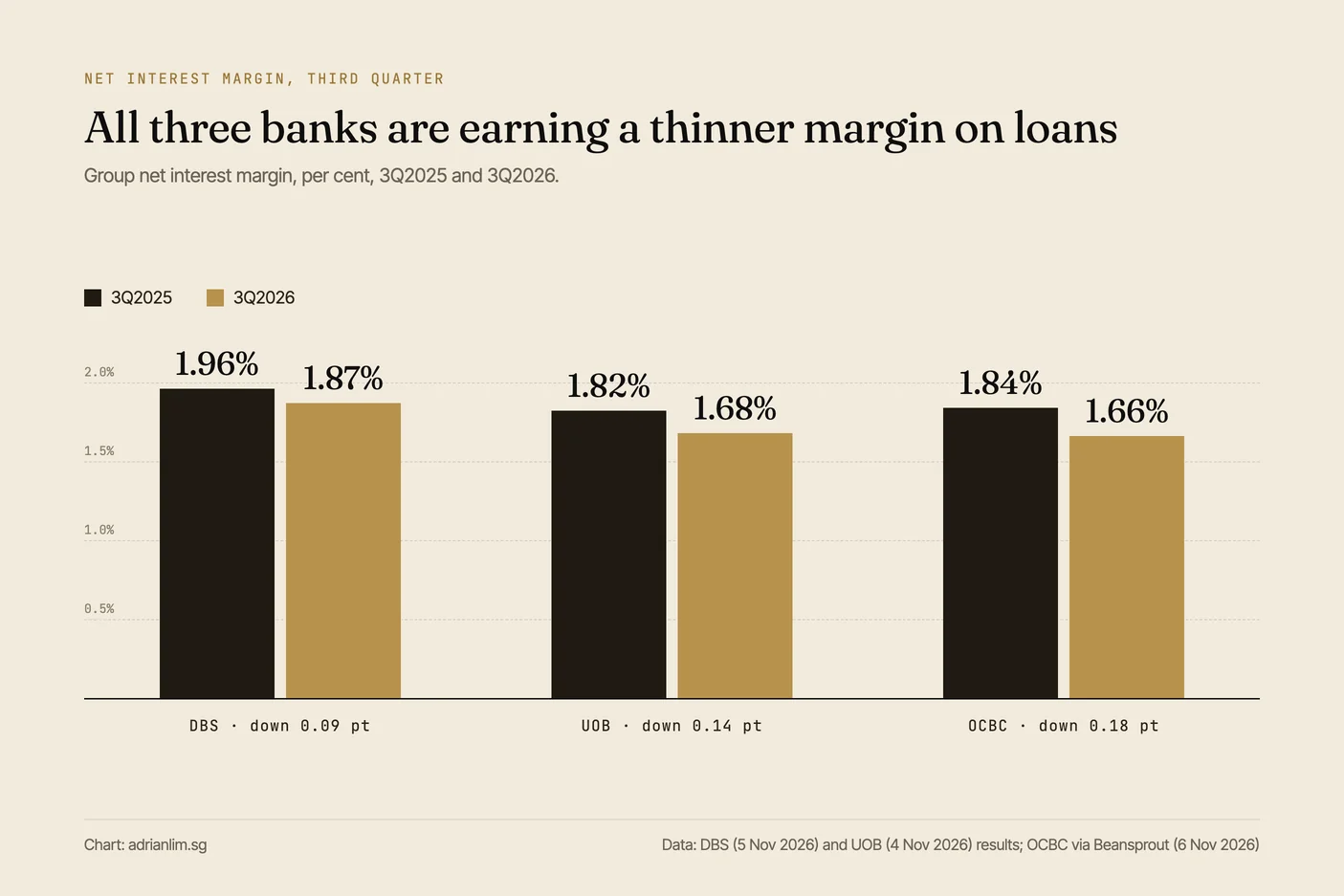
The banks are not in the same position. Ms Joanna Cheah, ASEAN research analyst at Jefferies, said UOB faces greater pressure from persistent margin compression, while the margins at DBS and OCBC started to recover at the end of the third quarter. UOB’s own results put its third-quarter margin at 1.68 per cent, down from 1.74 per cent in the second quarter amid higher funding costs, and pointed to margin compression “in a lower interest rate environment” over the year.
DBS is more upbeat. Its management said net interest income has bottomed out, and it expects mid-single-digit growth in total income next year. OCBC said it is well placed for higher rates.
What does this mean for my home loan?
This is the line in the results I would pay most attention to.
Sora, the Singapore Overnight Rate Average, is a benchmark published by MAS, and many loans reference it. DBS said Sora averaged 1.13 per cent in the first nine months of 2026, about half the level a year earlier. That was a big headwind for the banks. For many home owners on floating rates, it was a welcome relief.
That relief may be ending. At DBS’s results briefing, chief executive Tan Su Shan said: “Do not forget, interest rates only went up on 16 September.” She said DBS expects two more US Federal Reserve rate hikes between now and the end of next year, and is “looking for Sora to average 1.6% next year”.
To put that in plain numbers: 1.6 per cent is 0.47 percentage points above the 1.13 per cent average so far this year. As a rough illustration only, if your loan rate rose by that much on a S$1 million loan, you would pay about S$4,700 more in interest in the first year, or close to S$400 a month. Your own number depends on your package, your loan size and when your rate resets.
The banks’ thin margins are their problem. The direction of Sora is yours.
A forecast is not a promise. DBS itself said the outlook has become more uncertain, amid elevated energy prices, tighter financial conditions and geopolitical risks. Rates could rise faster, slower or not at all. That uncertainty is the point. A family budget that only works if Sora stays where it was this year has no room in it.
Fixed or floating: how should I think about it now?
I will not tell you which to pick. Nobody knows where rates will be in two years, and the right answer depends on each family’s numbers. But I can share the questions I would ask.
- If your instalment went up by a few hundred dollars a month, would it hurt, or merely annoy?
- How long do you expect to keep this home? If you might sell within the lock-in period, read the penalty terms carefully.
- Are you choosing a package because it is cheapest today, or because you could live with it if rates went the wrong way?
Floating rates suit families with a buffer who can absorb a rise. Fixed rates suit families who value a known payment more than the chance of a lower one. Both are reasonable. What I would avoid is choosing on the strength of a single forecast, whether that forecast is the bank’s, an analyst’s or mine.
Is now a good time to refinance?
It is a good time to look, which is not the same thing.
If your lock-in has ended, or ends soon, ask your current bank what it will offer to keep you, and compare that with other banks. If you are still locked in, work out the penalty before anything else. Then compare the full cost, not just the headline rate.
One thing from the results is worth knowing when you sit down with a banker. The banks want to grow. OCBC expects loan growth in the low double digits this year, and DBS said it expects a healthy loan pipeline next year. That does not guarantee you a better deal. But it does mean it is worth asking, and asking more than one bank.
What does this mean for buyers’ affordability?
If you are buying now, the sensible move is to test your budget against a higher rate, not the one in today’s offer letter.
I wrote last month about how buyers are putting in more cash and CPF, and about the rate swing of 2021 to 2022. The Straits Times reported that three-year fixed mortgage rates were around 1.15 per cent in late 2021, and that by November 2022, fixed-rate packages at the three local banks had reached between 4.25 and 4.5 per cent. Nobody quoted here is forecasting a jump like that, and DBS’s own forecast is far gentler. But the lesson holds: rates can move faster than family plans.
So before you commit, ask two questions. Could you still carry the loan comfortably if your rate rose by a full percentage point? And would you still have savings left after the down payment for the things with dates on them, like school fees or a parent’s care? If both answers are yes, a modest rise in Sora should not change your plans.
I own bank shares and a home. What should I watch?
Many families I work with hold DBS, OCBC or UOB shares, often for the dividends. Some quietly count on those dividends to help with the mortgage. This is where I would be careful.
DBS declared 81 cents a share for the third quarter, made up of a 66-cent ordinary dividend and a 15-cent capital return dividend. It said the annualised yield is 4.6 per cent. Read the fine print, though: that figure is based on the previous day’s closing price, and assumes dividends are held at 81 cents a quarter. Neither is guaranteed.

Bank shares have also been under pressure in recent weeks, along with the broader Singapore market, after climbing rapidly earlier in the year. “The recent sell-off appears to reflect a combination of earnings disappointment and weaker macroeconomic sentiment,” said an analyst from the digital brokerage MooMoo. Mr Cheng Chye Hsern, head of investment at Providend, said DBS has the steadiest outlook, but noted that its share price is nearly three times its book value, against a historical average of 1.6 times.
Here is the part families tend to miss. If rates rise, your mortgage costs more. At first, the same rise can squeeze bank margins, as Mr Xiao explained. So a home loan and a bank-share portfolio can come under pressure at the same time. In the short run, one does not protect you from the other.
None of this is a reason to sell your shares, and it is not my place to tell you to. It is a reason to keep the two decisions separate. Pay the mortgage from income you can rely on. Treat dividends as a bonus, not a salary. And if a large part of your wealth sits in one home and one sector’s shares, that is worth a conversation with a licensed financial adviser.
Ms Cheah offered some perspective. She said the recent weakness is partly a global risk-off mood and partly profit-taking after a strong rally. “We would distinguish this market volatility from Singapore fundamentals, which remain relatively defensive, supported by resilient earnings, a strong currency and healthy corporate balance sheets,” she said.
That matches how I approach property. Short-term noise is not a plan. A home loan you have stress-tested, a buffer you do not touch, and dividends you enjoy but do not depend on will see a family through a tougher year, for the banks or for anyone else.
If you are weighing a refinance, an upgrade or a sale, and want a second view on how the loan and the timing fit your family over the next decade, I am glad to talk it through.
The numbers
| Source | CNA, Abigail Ng, Nov 7, 2026 |
| 3Q2026 net profit | DBS S$2.81b (down 5%); UOB S$1.25b (up 182%); OCBC S$2.04b (up 3%) |
| DBS net interest margin | 1.87% in 3Q2026, down 9 basis points year on year; stable on the quarter |
| UOB net interest margin | 1.68% in 3Q2026, from 1.74% in 2Q2026 and 1.82% in 3Q2025 |
| OCBC net interest margin | 1.66% in 3Q2026, 18 basis points lower year on year (via Beansprout) |
| Sora, first nine months of 2026 | Averaged 1.13%, about half the level a year earlier (DBS) |
| DBS 2027 view | Sora to average 1.6%; two more US Fed rate hikes expected by end-2027; net interest income growth close to 5% |
| DBS 3Q2026 dividend | 81 cents a share (66 cents ordinary, 15 cents capital return); annualised yield 4.6% on DBS's stated assumptions |
| DBS valuation (Providend) | Share price nearly three times book value, against a historical average of 1.6 times |
| OCBC | Expects low double-digit loan growth in 2026; says it is well placed for higher rates |
Questions families ask
Why do analysts expect a tough 2027 for Singapore banks?
CMC Markets' Eric Xiao told CNA that the boom years did a lot of the work for the banks, and that cashing in on the wealth boom has been harder than expected. Margins have also thinned. Higher interest rates should help the banks eventually, but CMC Markets' Eric Xiao said margin income could be squeezed at first because deposit rates tend to rise faster than loan rates. Jefferies' Joanna Cheah said UOB faces greater earnings pressure from persistent margin compression.
Are Singapore interest rates going up or down?
After falling, they are turning up. DBS said Sora averaged 1.13 per cent in the first nine months of 2026, about half the level a year earlier. DBS chief executive Tan Su Shan noted that rates only went up on Sept 16, and DBS expects Sora to average 1.6 per cent in 2027, with two more US Federal Reserve rate hikes by the end of next year. That is the bank's forecast, not a certainty.
What does a higher Sora mean for my floating-rate home loan?
Loans that reference Sora move with it, so a higher Sora usually means higher instalments after each reset. As a rough illustration only: if your rate rose by 0.47 percentage points, the gap between the 1.13 per cent nine-month average and DBS's 1.6 per cent forecast, a S$1 million loan would cost about S$4,700 more in interest in the first year. Your actual change depends on your package and loan size.
Should I switch to a fixed-rate home loan now?
That depends on your family's cash flow, how long you plan to keep the home, and the lock-in terms on offer, so work it through with your banker and a financial adviser. The general principle is to choose the structure you can live with if rates go the wrong way, rather than the one that wins only if a forecast comes true.
I own DBS, OCBC or UOB shares. Can I count on the dividends to pay my mortgage?
It is safer not to. DBS said its annualised dividend yield is 4.6 per cent, but that assumes dividends are held at 81 cents a quarter and is based on the previous day's share price. Dividends can change, and bank shares have been under pressure in recent weeks. Your mortgage instalment is a fixed obligation. Plan to pay it from income, and treat dividends as a bonus.
Reporting referenced: CNA. Analysis and views are Adrian Lim's own.
Talking it through beats reading about it.
If this story touches a decision your family is weighing, send Adrian a message. A first conversation costs nothing and commits you to nothing.
WhatsApp Adrian · +65 8183 2333More from Insights

Bigger Loans, Less Borrowing: What More Cash and CPF Down Payments Mean for Upgraders
Home loans keep getting bigger, but buyers are borrowing a smaller share of what they pay. Here is how a family planning its next move should read that, and the rise in mortgagee sales alongside it.

Should Every Property Move Leave You Wealthier? The Honest Version
Treating your moves as a sequence rather than a series of one-offs is genuinely better thinking. It also breaks in two places, and both of them are expensive.
HDB Resale Prices Dip for a Third Straight Quarter: How to Read It
Million-dollar flats make the news. The index tells a quieter story: three soft quarters, steady buying and more supply on the way.