Bigger Loans, Less Borrowing: What More Cash and CPF Down Payments Mean for Upgraders
Home loans keep getting bigger, but buyers are borrowing a smaller share of what they pay. Here is how a family planning its next move should read that, and the rise in mortgagee sales alongside it.
The short read
OCBC's figures show home prices rose faster than loan sizes between 2021 and the first half of 2026: 49 per cent against 35 per cent for new private launches, and 36 per cent against 32 per cent for private resale. Buyers made up the gap with cash and CPF. Fewer OCBC new-launch buyers took the full 75 per cent loan-to-value limit: 52 per cent in 1H2026, down from 67 per cent in 2021.
Loans are still bigger in dollar terms, and ETC recorded 292 auction listings in 1H2026, the most for a half-year since 1H2021. ETC's Joy Tan said this could reflect a time lag, with cases including highly leveraged investors who bought between 2020 and 2022. For families, the lesson is to borrow with room to spare and stress-test the loan against the 2021-2022 rate swing.
Home prices in Singapore have climbed a long way in five years, and so have home loans. But new bank figures show the loans have not kept pace with the prices. Buyers are making up the difference themselves.
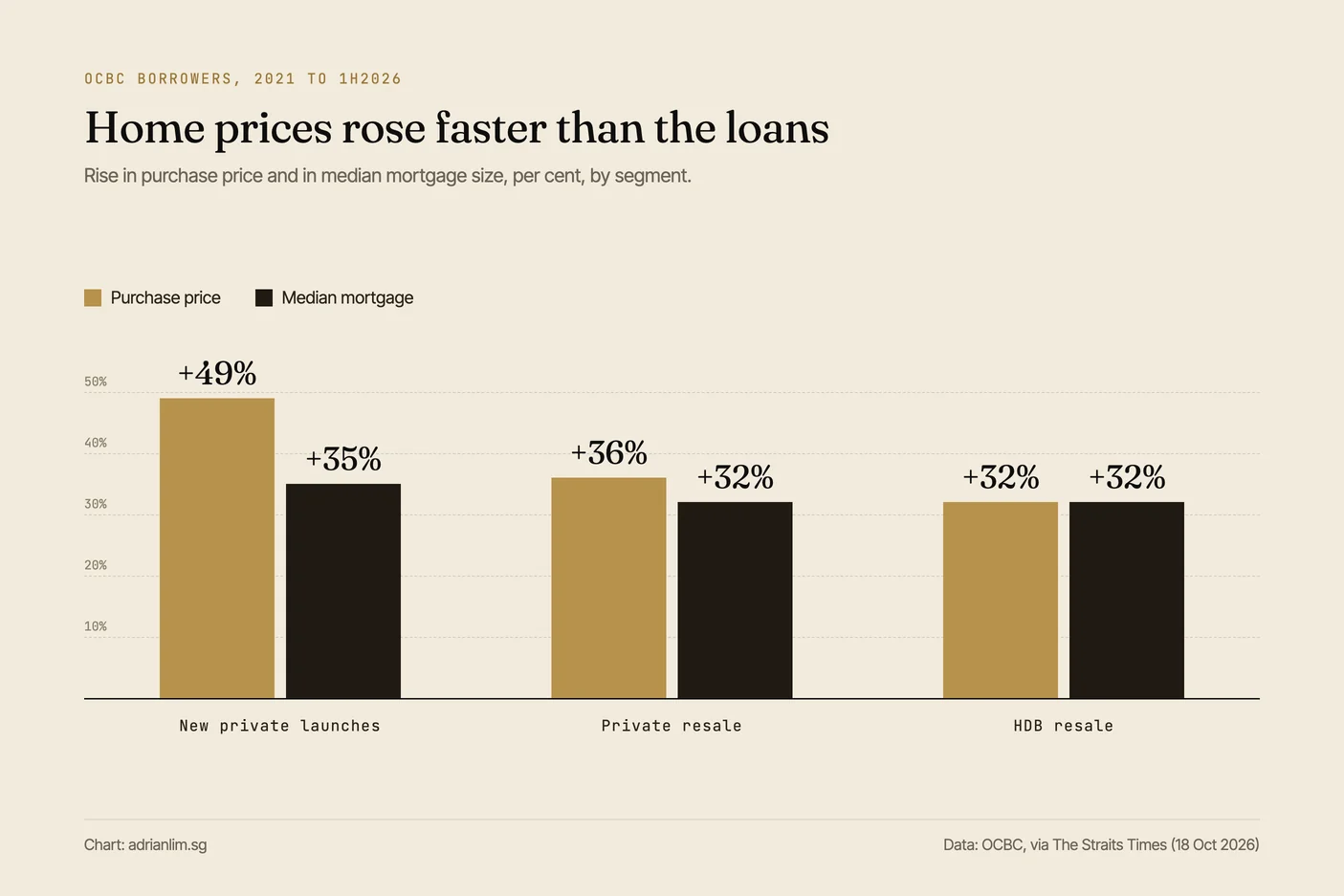
As The Straits Times reported on Oct 18, OCBC’s figures show that between 2021 and the first half of 2026, purchase prices of new private launches rose 49 per cent, while median mortgage sizes rose 35 per cent. For private resale homes, prices rose 36 per cent and mortgages 32 per cent. For HDB resale flats, both rose 32 per cent. OCBC financed more than a third of private property transactions in 2025, so this is a meaningful slice of the market.
Tok Geok Peng, OCBC’s group head of consumer secured lending, said buyers are not simply borrowing proportionately more. They are using more cash or CPF savings for their down payments. She put this down to borrowers’ incomes growing faster than property prices. “With the median age of our borrowers being around 38, most of them have saved up over the years or have sufficient CPF that can contribute to their property purchase, reducing the loan amount that they need,” she said.
Loans are still getting bigger in dollar terms. Nearly eight in 10 OCBC borrowers buying new private launches took loans of at least $1 million in the first half of 2026, up from four in 10 in 2021. At UOB, the average housing loan for private property grew at 8 per cent on average from 2023 to the first half of 2026, to more than $1 million.
And yet, property consultancy ETC recorded 292 auction listings from January to June 2026, the highest half-yearly total since the first half of 2021. Most were mortgagee sales.
I have spent 17 years helping families buy, sell and upgrade, often with parents and grown children in the same conversation. Here is how I read these numbers, and what I would take from them if you are planning your next move.
Are buyers borrowing more or less?
Both, depending on which number you look at. That is the confusing part, so it helps to separate them.
In dollars, loans are clearly bigger. Nearly eight in 10 new-launch borrowers at OCBC now take at least $1 million, against four in 10 in 2021. UOB said the share of its home buyers taking loans of $1 million or more rose by 15 percentage points from 2023 to 2025.
As a share of the price, borrowing is lower. That is what the gap in the chart below shows. For new launches, prices rose 14 percentage points more than loan sizes. The difference came from buyers’ own cash and CPF.
Fewer buyers are borrowing the maximum, too. Under the loan-to-value (LTV) limit, a borrower can generally finance up to 75 per cent of a property’s value for a first housing loan with a bank. Among OCBC customers buying new launches, the share taking the full limit fell from 67 per cent in 2021 to 52 per cent in the first half of 2026. For private resale buyers, it fell from 66 per cent to 61 per cent. Chelsea Ling, head of deposits and secured lending at DBS Singapore’s consumer banking group, said DBS’s LTV ratio for private home loans is also lower than a year ago.
So the honest summary is this: bigger loans, but less leverage. The loan has grown, but the share of the home’s price paid for with debt has shrunk.
Bigger loans and lower leverage can both be true. For a family, the second number matters more than the first.
Why would anyone not borrow the full 75 per cent?
Because the loan you can get and the loan you should carry are two different numbers.
A bank’s approval tells you the most it is willing to lend today. It cannot tell you what the next ten years hold for your family: a second child, a parent moving in, a change of job, a stretch of higher rates.
Putting in more of your own money does three things. It lowers your monthly instalment. It leaves more room if interest rates rise. And it leaves you more equity if you ever need to sell in a soft market. None of these show up on the day you sign. They show up years later, usually when you least expect to need them.
That is why I read the falling share of buyers taking the full limit as a healthy sign. Nearly half of OCBC’s new-launch buyers now borrow less than they could. OCBC and UOB both said borrowers’ debt-servicing levels have stayed broadly stable despite larger loans. DBS said the overwhelming majority of its customers continue to meet their repayments, and delinquencies remain extremely low.
Not borrowing the maximum is not leaving money on the table. It is buying room to breathe for the years you cannot see yet.
How should an upgrader think about the cash and CPF split?
I will keep this to principles, because the right split depends on each family’s numbers.
An upgrader’s down payment usually comes from some mix of sale proceeds from the current home, CPF savings and cash. Tok’s point about borrowers who have saved over the years matters here. A bigger down payment is a strength. But putting every dollar in is not automatically wise. Once money goes into the house, it is hard to get back out without selling or refinancing.
Before deciding how much to put down, I would ask three questions:
- After the down payment, how many months of instalments could you still cover if one income stopped?
- Is any of the cash set aside for something with a date on it, like school fees or a parent’s care?
- If rates moved the way they did in 2022, would the monthly payment still sit comfortably?
Some families lean on CPF and keep more cash in hand. Others do the reverse. There is no single right answer, and the split is worth working through with your banker and a financial adviser, not just your agent. My part is making sure the property side of the plan, the sale price you can realistically expect and the timing between selling and buying, rests on real numbers. I wrote more about that in whether every property move should leave you wealthier.
For HDB owners planning to upgrade, note one detail in OCBC’s figures. For HDB resale flats, prices and median mortgages both rose 32 per cent, so loans kept pace with prices there. The extra cash and CPF showed up on the private side, which is where upgraders are heading.
What does the 2021-2022 rate swing teach us?
It shows how fast the ground can move.
Three-year fixed mortgage rates were around 1.15 per cent in late 2021, before climbing sharply as global interest rates rose. By November 2022, fixed-rate packages at the three local banks had reached between 4.25 and 4.5 per cent. That happened in about a year.
It also came during the market’s strongest run in years. Private home prices rose 2.2 per cent in 2020, then 10.6 per cent in 2021 and 8.6 per cent in 2022. Growth then slowed: 6.8 per cent in 2023, 3.9 per cent in 2024, 3.3 per cent in 2025 and 1.4 per cent in the first half of 2026.
Put those together and you can see the risk for a buyer who stretched in those years. A large loan, taken when money was very cheap. Repayments that could rise sharply once rates moved. And prices that kept rising, but more slowly each year, so there was less of a cushion from growth.
This is the stress test I would apply to any plan today. Do not build the budget only on the rate in your offer letter. Ask whether your family could carry the loan if rates moved as far and as fast as they did between late 2021 and late 2022. If the answer is yes, with room to spare, the plan is sound. If the answer needs everything to go right, the loan is too big, however much the bank is willing to lend.
Stress-test your loan against the swing we have already lived through, not just the rate on today’s offer letter.
Why are mortgagee sales rising if borrowers look healthy?
It looks like a contradiction. Mostly, it is not.
Of ETC’s 292 auction listings in the first half of 2026, 216, or 74 per cent, were mortgagee sales, where a bank puts a property up for sale after the borrower defaults. Residential properties made up 144 listings, almost half the total. Industrial and retail properties made up the rest.
Joy Tan, head of auction and sales at ETC, a member of Realion Group, said the explanation could be a time lag. “Banks do not repossess and auction a property after a single missed payment. Home owners are typically given time to restructure, refinance, or sell via private treaty,” she said. “As a result, a mortgagee-sale listing usually reflects financial pressure that has been building over several years rather than a sudden, recent deterioration.”
She said the cases include highly leveraged investors who bought between 2020 and 2022. They also include owners of investment or rental properties whose rental income may no longer cover mortgage instalments, maintenance fees and taxes.
So I read the rise as a lagging signal from the last cycle, not the start of a crash. The bank data describes today’s borrowers, many of whom, OCBC says, have saved up over the years and are leaning less on debt. The auction list describes, in part, people who borrowed heavily during the cheap-money years and are still working through it.
That is no reason to be complacent. Tan expects auction activity to remain active in the second half of 2026, though the pace could moderate. She said the level will depend on interest rates, job market conditions, business performance, and whether banks continue to give distressed borrowers time to restructure. Those are worth watching. But a family buying a home to live in, with a loan it has stress-tested, is in a very different position from an investor who stretched for a rental property between 2020 and 2022.
The pattern across these figures is buyers choosing room over reach. That is the habit I would copy. If you are planning an upgrade and want a second view on how the sale, the purchase and the loan fit together over the next decade, I am always glad to talk it through.
The numbers
| Source | The Straits Times, Joyce Lim, Oct 18, 2026 |
| New private launches (OCBC) | Purchase prices +49%, median mortgage +35% (2021 to 1H2026) |
| Private resale (OCBC) | Purchase prices +36%, median mortgage +32% |
| HDB resale (OCBC) | Purchase prices and median mortgage both +32% |
| New-launch loans of $1m or more (OCBC) | Nearly 8 in 10 borrowers in 1H2026, up from 4 in 10 in 2021 |
| Buyers taking the full 75% LTV (OCBC) | New launches 67% (2021) to 52% (1H2026); private resale 66% to 61% |
| Median OCBC borrower age | Around 38 |
| UOB private housing loans | Average loan quantum grew 8% on average from 2023 to 1H2026, to more than $1m; share of $1m+ loans up 15 percentage points from 2023 to 2025 |
| DBS | LTV ratio for private home loans lower year on year; delinquencies extremely low |
| Auction listings (ETC) | 292 in Jan to Jun 2026, highest half-year since 1H2021; 216 (74%) mortgagee sales; 144 residential |
| Private home price growth | 2020 2.2%; 2021 10.6%; 2022 8.6%; 2023 6.8%; 2024 3.9%; 2025 3.3%; 1H2026 1.4% |
| Three-year fixed mortgage rates | Around 1.15% in late 2021; 4.25% to 4.5% at the three local banks by November 2022 |
Questions families ask
Are Singapore home buyers borrowing more or less?
Both, depending on the measure. In dollar terms, loans are bigger: nearly eight in 10 OCBC borrowers buying new private launches took loans of at least $1 million in the first half of 2026, up from four in 10 in 2021. As a share of the price, borrowing is lower: OCBC's figures show new-launch prices rose 49 per cent from 2021 to the first half of 2026 while median mortgage sizes rose 35 per cent, with buyers covering the gap with cash or CPF.
What is the 75 per cent loan-to-value limit?
Under the loan-to-value (LTV) limit, a borrower can generally finance up to 75 per cent of a property's value for their first housing loan with a bank. Among OCBC customers buying new private launches, the share taking the full limit fell from 67 per cent in 2021 to 52 per cent in the first half of 2026. For private resale buyers, it fell from 66 per cent to 61 per cent.
Why are mortgagee sales rising if borrowers look healthy?
ETC's Joy Tan said it could be a time lag. Banks do not repossess and auction a property after a single missed payment, so a mortgagee-sale listing usually reflects pressure that built up over several years. She said the cases include highly leveraged investors who bought between 2020 and 2022, and owners of rental properties whose rental income may no longer cover instalments, maintenance fees and taxes.
How much did mortgage rates rise in 2022?
According to The Straits Times, three-year fixed mortgage rates were around 1.15 per cent in late 2021. By November 2022, fixed-rate packages at the three local banks had reached between 4.25 and 4.5 per cent.
Should I borrow the full 75 per cent?
That depends on your family's income, savings and plans, so it is worth working through with your banker and a financial adviser. The general principle is that the maximum loan a bank will give is not the same as the loan you should carry. A smaller loan means lower instalments and more room if rates rise, which is why it helps to test any plan against the rate swing of 2021 to 2022.
Reporting referenced: The Straits Times. Analysis and views are Adrian Lim's own.
Talking it through beats reading about it.
If this story touches a decision your family is weighing, send Adrian a message. A first conversation costs nothing and commits you to nothing.
WhatsApp Adrian · +65 8183 2333More from Insights
Should Every Property Move Leave You Wealthier? The Honest Version
Treating your moves as a sequence rather than a series of one-offs is genuinely better thinking. It also breaks in two places, and both of them are expensive.
HDB Resale Prices Dip for a Third Straight Quarter: How to Read It
Million-dollar flats make the news. The index tells a quieter story: three soft quarters, steady buying and more supply on the way.

Seized Condos at Auction: What Four Sales and 15 Withdrawals Really Signal
Four sales, 15 withdrawals and a S$25.3 million penthouse nobody bid on. The results say more about how auctions work than about where prime prices are heading.