Therme at Marina South: What a 2030 Wellness Hub Does to Home Values
A 720,000 sq ft wellness destination is a real catalyst for Marina South. It is also five years away, and that gap is where families get the decision wrong.
The short read
Therme Singapore broke ground at Marina South on 19 June 2026 and opens in 2030: seven storeys, more than 720,000 sq ft, 20-plus pools, 18 water slides and a projected two million visitors a year. It is genuine lifestyle infrastructure, not a mall with a gym, and it strengthens the residential case for Marina South.
But a catalyst five years out prices in slowly, not overnight. The families who do well around megaprojects are the ones who would have bought the home anyway and let the catalyst settle underneath them. Buy Marina South if the home fits your family through 2032 and beyond; the wellness hub is then a bonus, not the thesis.
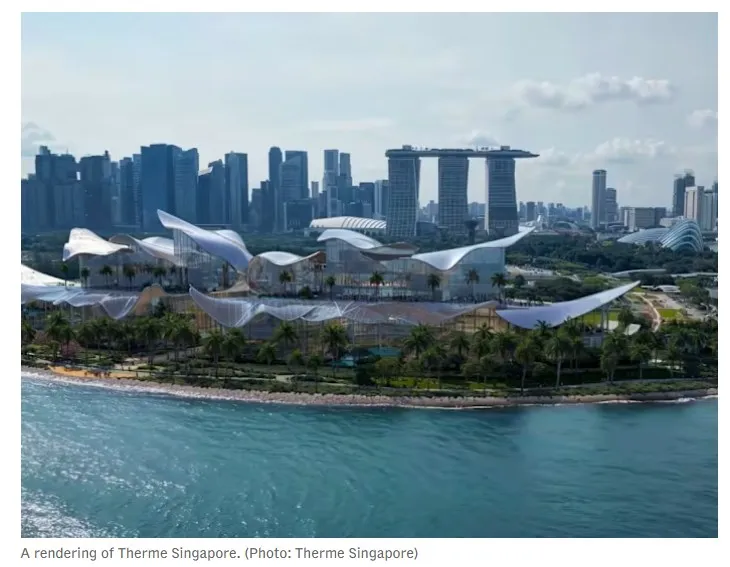
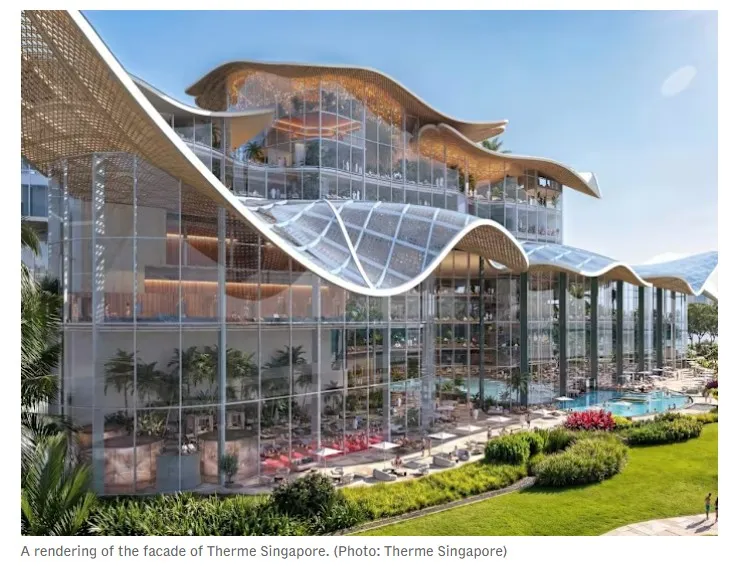
Therme Group broke ground at Marina South on 19 June 2026, and as CNA reported, what is coming by 2030 is not a spa. Therme Singapore will be seven storeys and more than 720,000 sq ft of gross floor area, roughly nine football fields, holding more than 20 pools, 18 water slides totalling over 1.8km, 70-plus wellness treatment rooms, and over 200,000 plants inside the building itself. A coastal park of around four hectares will connect it to the Marina Barrage. The group is billing it as Asia’s first large-scale integrated well-being destination, and projecting about two million visitors a year at full capacity, roughly half of them international.
The names on the podium tell you how seriously Singapore is taking it. Therme Group Asia is chaired by Mah Bow Tan, a former Minister for National Development. Founder and CEO Robert Hanea described the vision as “a new form of social infrastructure, where wellbeing is accessible, joyful and integrated into everyday city life.”
So within a week, the property takes wrote themselves: Marina South just got its anchor, get in before 2030. That is the part I want to slow down, because most of those takes are confusing a five-year corridor with a five-week window. They are not the same thing.
What exactly is being built at Marina South?
The location matters more than the slides. Therme sits on the Marina South waterfront, next to the Marina Barrage and Gardens by the Bay, a short walk from the Gardens by the Bay MRT station, facing the Singapore Strait.
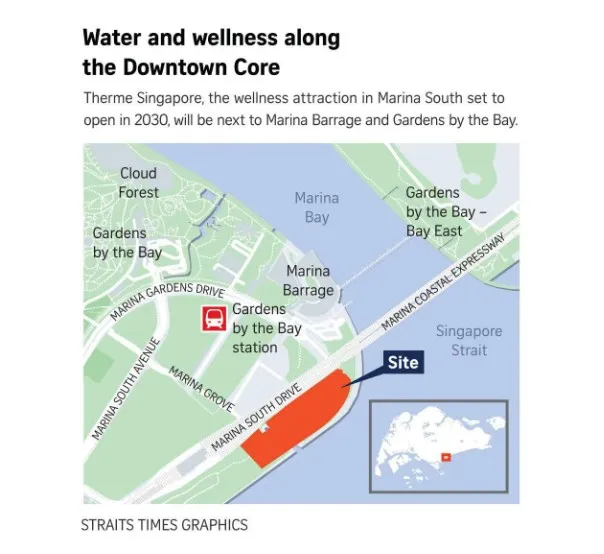
That puts it at the seam of two Singapores. On one side, the Downtown Core and everyone who works in it. On the other, the new Marina South residential precinct the government has been assembling plot by plot, master-planned as a car-lite neighbourhood in the extended bay area. Until now, the honest criticism of Marina South as a place to live was that it had a postcode and a plan but no life: no anchor that gives a neighbourhood a reason to exist on a Sunday.
Therme is that anchor, and it is a specific kind of anchor. The three zones, family water play, mineral pools and quiet water, saunas and cold plunge, are designed to pull three generations through the same door. Mah Bow Tan was explicit about the intent: catering “from heartlanders, senior citizens all the way to the Gen Z, millennials working in Downtown”, with scale used to keep pricing accessible. Entry fees have not been announced, so hold that claim loosely, but the stated design brief is mass, repeat, local use, not a one-off tourist ticket.
Does lifestyle infrastructure actually raise property values?
Here is the distinction I keep coming back to with families: there is amenity that rents, and there is amenity that appreciates. They look similar in a launch brochure. They behave very differently over a decade.
Amenity that rents is proximity convenience. A mall downstairs, an MRT exit, a food centre. It makes a unit easier to tenant and slightly stickier at resale, and its value is largely priced in the day it opens, because everyone can see it and count the minutes to it.
Amenity that appreciates is rarer. It changes who wants to live in a precinct at all. Gardens by the Bay did this for the bay area: it did not shave minutes off anyone’s commute, it changed what living there meant. If Therme delivers, it belongs to this second category. A place three generations of one family can spend a Saturday, at a price point pitched at heartlanders, next to a barrage and a garden, is a reason for a certain kind of household to choose Marina South over a dozen equally connected districts.
Amenity that rents shows up in next quarter’s yield; amenity that appreciates shows up in your exit pool fifteen years later.
That is also why the second kind is slower. The value does not arrive at the ribbon-cutting. It arrives as the precinct accumulates residents who chose it for that reason, and it is confirmed only when you sell, in the depth and quality of the buyer pool standing in your living room. Apply the future-buyer test to Marina South in 2040: who buys this home from you? A family that wants the bay, the gardens, the waterfront park and yes, the wellness campus, as their ordinary weekend. That is a better future buyer than a yield-chaser who bought a headline.
Why a 2030 opening is not a 2026 buying signal
Across seventeen years and several property cycles, I have watched precincts change before their skylines did. Marina Bay after the integrated resorts. Paya Lebar after the masterplan. Jurong Lake District. The pattern is consistent enough that I treat it as a rule: catalysts announced years in advance price in slowly, in waves, and the first wave has usually already happened by the time you read the headline, because developers bid for the land knowing the story.
The families who did well around those transformations were not the ones who sprinted at the announcement. They were the ones who would have bought the home anyway, for their own reasons, and let the catalyst settle in underneath them over the years they were always going to hold. The ones who chased the headline often paid the premium twice: once at entry, when the story was priced at its most optimistic, and again in holding cost, through the long quiet years between groundbreaking and life.
A five-year corridor is not a five-week window, and the market will not reward you for pretending otherwise.
And five years is the corridor here, minimum. The story arrives early; the liveability arrives late. Between now and 2030, Marina South is a construction zone with a beautiful masterplan. After 2030, it is a new precinct finding its rhythm. The residential value of Therme is realised across the 2030s, not at its opening weekend.
Who should act on this, and who should not?
The honest read is different for each profile, so I will keep them separate.
| Profile | The read |
|---|---|
| Investors | With a clear thesis and genuine holding power, positioning early in a precinct with a confirmed anchor is defensible. Without the holding power, you are paying today for value that arrives in waves you cannot schedule. |
| HDB upgraders | Do not stretch into Marina South for a 2030 story. A stretched budget plus a five-year runway plus a precinct still under construction is three risks stacked. There are better-fitting homes for your next decade. |
| Right-sizers | The lifestyle case is genuinely compelling: waterfront, gardens, a wellness campus designed partly for seniors, all car-lite and flat. But that is a lifestyle decision, and it deserves to be made as one, not dressed up as an investment call. |
One more thing worth saying plainly: Marina South is not trophy-tier, and it may not be by 2030. For the families this precinct actually serves, that is a feature. Trophy precincts price in prestige; this one is being built to price in daily life. The second kind tends to be the better long-term home, and the more forgiving long-term asset.
The question to ask before the 2030 question
If your family is the kind I usually sit with, two generations under one roof or heading that way, a seven-year horizon on one side and a twenty-year horizon on the other, then the question is not whether Marina South appreciates by 2030. You cannot control that, and neither can Therme.
The question is whether a home there still holds your family in 2032, wellness hub or not. Does the layout work when a parent moves in? Does the precinct work for a teenager, and for a knee that no longer likes stairs? Does your timeline match the precinct’s timeline, or are you asking a neighbourhood that finishes in the 2030s to perform inside your five-year plan?
If the answer is yes, the catalyst is a bonus, and a substantial one. If the answer is no, the catalyst is a trap, because it will keep you holding a home that does not fit while you wait for a payoff that was always going to take its time. That is the whole read. Everything else is renderings.
If you are weighing Marina South against a home that fits less gloriously but sooner, that is exactly the kind of decision my practice exists for, and it usually starts as a conversation, not a viewing.
The numbers
| Project | Therme Singapore, Marina South |
| Groundbreaking | 19 June 2026 |
| Opening | 2030 |
| Scale | 7 storeys, 720,000+ sq ft GFA |
| Water | 20+ pools; 18 slides totalling 1.8km+ |
| Wellness | 70+ treatment rooms; saunas, steam rooms, cold plunge |
| Projected visitors | ~2 million a year at full capacity, about half international |
| Entry fees | Not yet announced |
Questions families ask
Will Therme Singapore increase property prices in Marina South?
It strengthens the case for the precinct, but not on the timeline most people imagine. Catalysts announced years ahead price in slowly and in waves, and some of the benefit is already reflected in what developers paid for the land. Expect Therme to support Marina South values over a decade, not to spike them by 2030.
Is Marina South a good place to buy for owner-occupiers?
It depends on your decade, not Therme's. Marina South is being built as a residential precinct next to Gardens by the Bay and the Marina Barrage, and the lifestyle case is genuinely strong. But it is a precinct under construction, so the first years of living there will be quieter and rougher than the renderings. If the home fits your family through 2032 and beyond, it works. If you need it to perform by 2030, you are speculating.
Should I buy near a megaproject before it opens?
Only if you would have bought the home without it. Across seventeen years I have watched families do well around Marina Bay, Paya Lebar and Jurong Lake District, and the pattern is consistent: the winners bought homes that fitted their lives and let the catalyst settle underneath them. The ones who sprinted at the headline often paid the premium twice, once at entry and again in holding cost.
What is the difference between amenity that rents and amenity that appreciates?
Amenity that rents makes a unit easier to tenant next quarter, like a mall or an MRT exit downstairs. Amenity that appreciates changes who wants to live in a precinct permanently, and shows up in your exit pool fifteen years later. Therme is closer to the second kind, which is why its effect will be slower and more durable than a headline suggests.
When will Therme Singapore open and how much will entry cost?
It is slated to open at Marina South in 2030, following the June 2026 groundbreaking. Entry fees have not been announced, though Therme Group's Asia chairman has said the scale is meant to keep pricing accessible, from heartlanders to downtown professionals. Treat any specific price you hear before an official announcement as a guess.
Reporting referenced: CNA. Analysis and views are Adrian Lim's own.
Talking it through beats reading about it.
If this story touches a decision your family is weighing, send Adrian a message. A first conversation costs nothing and commits you to nothing.
WhatsApp Adrian · +65 8183 2333More from Insights
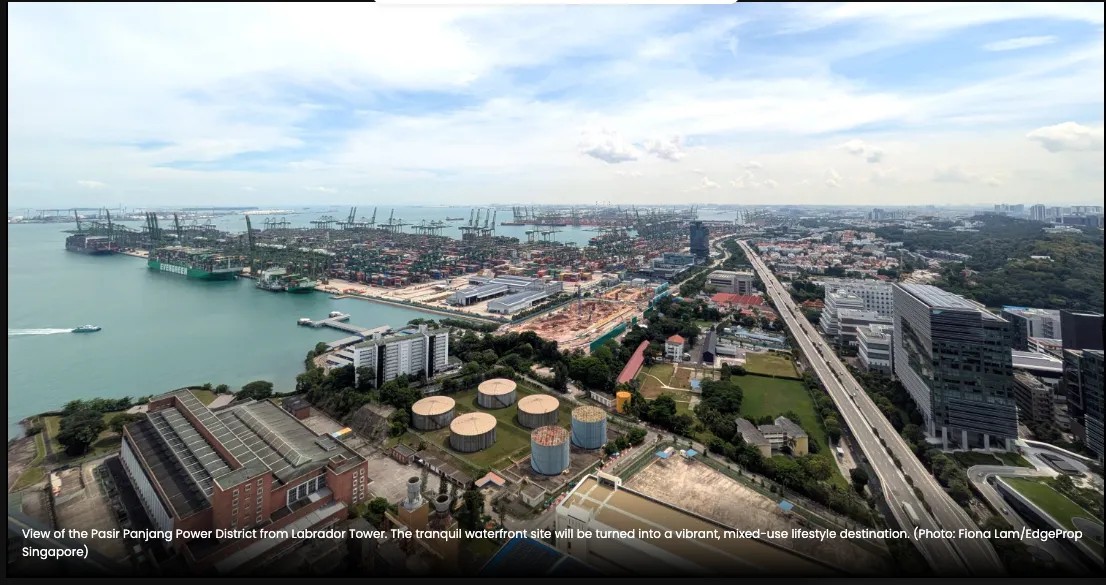
The Greater Southern Waterfront: Reading a 30km Story on Family Time
A 30-kilometre transformation is not one decision. It is several, on different clocks — and the clock that matters most is your family's.
One Marina Gardens at $3,290 psf: What a Record High Really Signals
A new print at the top of District 1 is real news. It is also, for most Singapore families, scenery — and knowing the difference is worth more than the headline.
What OpenAI's S$300 Million Actually Means for Your Home
A capability story and a price story move at very different speeds — and confusing the two is how families overpay for headlines.